
Many people spend years thinking they are allergic to cosmetics or that their skin is simply “difficult”. In reality, it is often sensitive skin — a condition with clear triggers and, most importantly, approaches that can help. Sensitive skin is not a disease, and it does not mean you need to give up skincare. It simply means your skin needs a more careful approach, the right ingredients and a routine that respects its needs. In this article, you will learn how to recognize sensitive skin, why it happens and which natural ingredients can help calm the skin and support its protective barrier.
Contents
- What is sensitive skin and how to recognize it
- Why sensitive skin happens: mechanisms and causes
- Natural ingredients and products for sensitive skin care
- How to build a routine for sensitive skin
- Why most sensitive skin advice does not work (and what actually makes a difference)
- Natural care for your sensitive skin with La PIEL
- Frequently asked questions about sensitive skin
Key takeaways
| Point | Details |
|---|---|
| Sensitive skin is not a disease | It is a condition in which the skin reacts more strongly to different triggers, but it is not a medical diagnosis on its own. |
| Barrier repair is key | Skincare should focus on supporting the skin barrier and avoiding aggressive ingredients. |
| Natural ingredients can help | Ingredients such as calendula, plant oils and soothing extracts can help reduce discomfort and support hydration. |
| Listen to your skin | The best results come from a personalized routine and careful observation of how your skin reacts. |
What is sensitive skin and how to recognize it
Once you understand the basic definition, it is important to know how to recognize this condition. Sensitive skin is not a formal medical diagnosis, but a skin condition that reacts easily to external and internal triggers, with symptoms such as redness, stinging, itching, tightness and dryness. This means there is no single test that always confirms skin sensitivity, but the symptoms are recognizable enough to notice on your own.
It is important to distinguish sensitive skin from an allergy. An allergic reaction involves an immune response to a specific substance, such as nickel or a certain preservative, and usually appears as a rash, swelling or intense itching. Sensitive skin, on the other hand, can react to a wider range of triggers without a classic immune reaction. The skin may become red after washing with cold water, sting when applying a cream or feel tight in the wind.
The most common symptoms of sensitive skin include:
- Redness that appears without a clear reason or after contact with a specific product
- Stinging or burning when applying cosmetics, even products made for sensitive skin
- Tightness, especially after cleansing the face or showering
- Dryness and flaking that do not improve with regular moisturizing care
- Itching that may become worse with temperature changes or during stressful periods
Many people notice their symptoms get worse in winter, when the air is dry and cold, or when switching to a new product. This is not a coincidence. Skin reacts to environmental changes just as much as it reacts to changes in your skincare routine.
Sensitive skin is not a weakness. It is a signal that your skin is communicating with you and asking for a more careful approach.
If you recognize these symptoms, useful tips for sensitive skin can help you take the first steps. For skin that is both dry and sensitive, a detailed guide to natural care for dry and sensitive skin offers a step-by-step approach.
Why sensitive skin happens: mechanisms and causes
Now that we know the symptoms, the next question is: why does sensitive skin happen? The primary mechanism is often a weakened skin barrier (stratum corneum), which can allow irritants and allergens to penetrate more easily and increase moisture loss. This may lead to discomfort, neurogenic inflammation and increased sensitivity of nerve endings. The stratum corneum is the outer protective layer of the skin, and when it is healthy, it acts like a protective shield.

When that shield is weakened, environmental irritants come into contact with the skin more easily. Nerve endings can become more sensitive and send signals of stinging, pain or discomfort even in response to mild triggers. The result is skin that reacts with redness, tightness or stinging to things that would not usually bother a stable skin barrier.
| Risk factor | How it affects the skin |
|---|---|
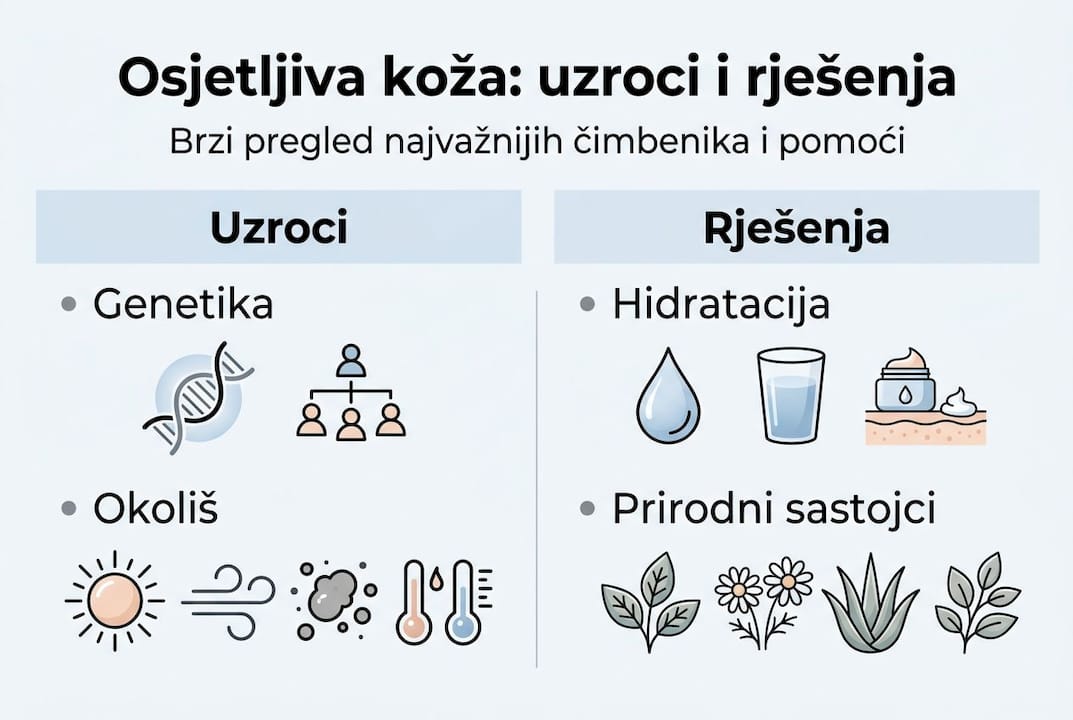
| Genetics | Inherited tendency toward a thinner or more reactive skin barrier |
| Environmental stress | Cold, wind and pollution can weaken the protective layer |
| Aggressive cosmetics | Alcohol, fragrance and strong acids can disrupt the skin’s balance |
| Stress and hormones | Cortisol and hormonal changes can affect the skin barrier’s ability to recover |
| Diet | Lack of certain nutrients, such as omega-3 fatty acids, can affect skin structure |
Interestingly, skin sensitivity can also develop in people who did not have it before. Hormonal changes, long-term use of aggressive products or excessive facial cleansing can weaken the barrier over time. Learning how to recognize the causes of a weakened skin barrier can help you better understand what may have triggered the change in your skin.
Winter is a particularly critical period because low temperatures and indoor heating can additionally dry out the skin. If you are preparing your skin for colder months, this guide to preparing dry and sensitive skin offers practical steps.
Professional tip: If you notice your skin becoming increasingly sensitive, check the ingredients in your current products. Alcohol denat., synthetic fragrances and aggressive preservatives are common triggers that can gradually disrupt the skin barrier.
Natural ingredients and products for sensitive skin care
Understanding the causes helps you choose better skincare products. Research suggests that calendula may help reduce moisture loss and increase hydration, while some studies have shown the potential of certain plant oils in caring for skin prone to irritation. Honey and oils such as immortelle and argan are often used in formulas designed for dry and reactive skin.
For skin barrier support, ceramides, squalane and calendula are especially useful, as they are associated with better hydration and reduced discomfort in sensitive and dry skin. These ingredients do not only improve the feeling of comfort, but also support the skin’s protective function.
| Ingredient | Action | Natural or synthetic |
|---|---|---|
| Calendula | Helps calm the skin and reduce moisture loss | Natural |
| Immortelle oil | Supports comfort and care for reactive skin | Natural |
| Argan oil | Hydrates, softens and supports the skin barrier | Natural |
| Ceramides | Help restore the structure of the skin barrier | Natural and synthetic |
| Hyaluronic acid | Attracts and retains moisture | Natural and synthetic |
The advantage of well-chosen natural ingredients for sensitive skin lies in their gentleness and compatibility with the skin’s needs. Synthetic equivalents can also be effective, but with sensitive skin it is important to look at the entire formula, including fragrances, preservatives, emulsifiers and other supporting ingredients that can affect tolerance.
The most important criteria when choosing products for sensitive skin:
- Fragrance-free, because fragrance is one of the most common irritants
- Free from alcohol in high concentrations, because it can dry out and irritate the skin
- A short ingredient list, because fewer ingredients usually mean a lower risk of reaction
- Dermatologically tested, which can provide additional reassurance when choosing a product
You can find more about which natural skincare ingredients may be useful in our detailed guide. For specific dryness-related advice, these tips for dry skin care can also help.
How to build a routine for sensitive skin
Introducing the right ingredients and products works best when supported by the right routine. Because sensitive skin reacts easily to external and internal triggers, the routine should be adapted to its specific needs, not copied from generic skincare guides.
Recommended steps for daily sensitive skin care:
- Cleansing with gentle micellar waters or creamy cleansers without foam and fragrance. Avoid hot water because heat can increase redness and discomfort.
- Toner without alcohol, with soothing ingredients such as aloe vera or panthenol. This step is not mandatory, but it can help the skin feel fresh and comfortable.
- Serum with hyaluronic acid, calendula or other soothing ingredients for hydration and skin comfort.
- Moisturizer with ceramides or plant oils to help retain moisture and protect the skin barrier.
- Sun protection every day, even in winter. For sensitive skin, mineral filters such as zinc oxide are often chosen because many people tolerate them better.
Besides products, lifestyle habits also play an important role. Stress increases cortisol levels, which can negatively affect the skin barrier. A diet rich in omega-3 fatty acids, antioxidants and enough water can support skin health from within.
Professional tip: Introduce one new product per week, not everything at once. That way, if a reaction occurs, it is easier to identify which product triggered it. Wait at least seven days before introducing the next new product.
Avoid aggressive physical scrubs with harsh particles, products with high percentages of acids and heavily fragranced creams, especially in the evening. For inspiration on how to build sustainable care for sensitive skin and a natural routine for glowing skin, explore our detailed guides.
Why most sensitive skin advice does not work (and what actually makes a difference)
Based on everything you have read, it is worth adding a practical perspective. Most generic advice for sensitive skin starts from the assumption that there is one universal approach. But sensitive skin is not the same for everyone. What calms one person’s skin can trigger a reaction in another.
The biggest problem is often buying products with long ingredient lists in the hope that “something in there will help”. In reality, every additional ingredient can increase the risk of a reaction. With sensitive skin, less is often truly more.
Three things can genuinely make a difference: first, reduce your routine to the minimum until the skin stabilizes. Second, keep a short skin diary and write down what you used and how your skin reacted. Third, stop looking for quick fixes and give your skin at least four weeks to adjust to new products. Personalization, patience and a return to simplicity often bring better results than expensive serums with twenty active ingredients. For more personal experiences and practical insights, visit our blog.
Natural care for your sensitive skin with La PIEL
If you want to make a change in your beauty routine, start with products that respect the needs of sensitive skin.
La PIEL offers face and body products formulated with carefully selected ingredients and a focus on comfort, hydration and everyday skin care. Every product is made in Croatia, with a carefully selected composition that respects the needs of sensitive skin. Explore face care products and find formulas that support the skin barrier instead of additionally burdening it. For a complete routine, take a look at natural body care and choose products according to your skin’s needs.
Frequently asked questions about sensitive skin
What are the most common symptoms of sensitive skin?
The most common symptoms are redness, stinging, tightness, itching and a feeling of dryness. They can appear as a reaction to external triggers such as cold, wind or certain cosmetic ingredients. Sensitive skin is not a formal medical diagnosis, but a condition that requires adapted care.
Is sensitive skin the same as an allergy?
No, sensitive skin is not the same as an allergy. An allergy involves a specific immune response to a certain substance, while sensitive skin can react to a wider range of triggers without that same mechanism.
Which ingredients and products should be avoided with sensitive skin?
With sensitive skin, it is generally recommended to avoid alcohol in high concentrations, fragrance, aggressive cleansers and overly frequent use of strong exfoliants or acids, because they can further irritate the skin and weaken the protective barrier.
How can I calm sensitive and irritated skin?
Choose gentle, soothing ingredients such as calendula, hyaluronic acid, ceramides, argan oil and immortelle, and avoid hot water and rough towels. It is important to simplify the routine until the skin feels calm again.
