
Most natural skincare routines skip one key step that can determine whether the skin looks healthy, fresh and protected. Antioxidants are often overlooked, even though they are one of the skin’s first lines of defence against everyday damage caused by sun exposure, pollution and stress. If your skin is sensitive, prone to redness or starting to show the first visible signs of ageing, understanding the role of antioxidants can change your entire skincare routine. In this article, you will learn how antioxidants work, what benefits they bring to sensitive skin, what studies show and how to safely introduce them into daily skincare.
Contents
- How antioxidants work and why they are key for skin
- Benefits of antioxidants for sensitive skin
- Synergy, best sources and effectiveness: what studies show
- Safe use and common mistakes when using antioxidants
- What experts and experience reveal: common myths and the real truth about antioxidants
- How to choose and order natural antioxidants for your routine
- Frequently asked questions about antioxidants in skincare
Key takeaways
| Point | Details |
|---|---|
| Antioxidants help protect the skin | By neutralising free radicals, they help slow down visible signs of ageing and support skin elasticity. |
| They are especially useful for sensitive skin | They can help calm redness and inflammatory processes while supporting the skin’s natural barrier. |
| Synergy is more effective | The best results are often achieved by combining multiple antioxidants, but with moderate and correct use. |
| It is important not to overdo it | Very high concentrations can irritate the skin and, with some ingredients, may trigger a pro-oxidant effect. |
How antioxidants work and why they are key for skin
Once we understand how important antioxidants are, the next step is to understand how they actually work on the skin.
Free radicals are unstable molecules that form in the skin as a result of exposure to UV rays, pollution, cigarette smoke and stress. They attack healthy cells, damage collagen and elastin, and accelerate visible signs of ageing. This process is called oxidative stress and is one of the main causes of loss of elasticity, wrinkles and a weakened skin barrier.
To understand what antioxidants are and how they work, it is important to know that they donate an electron to free radicals, neutralising them and stopping the chain reaction of damage. Antioxidants neutralise free radicals by donating electrons, helping prevent oxidative stress that contributes to skin ageing, collagen damage and loss of elasticity.
The most important antioxidants in skincare are:
- Vitamin C (ascorbic acid): supports collagen synthesis, helps even out the complexion and protects the skin from the effects of UV damage
- Vitamin E (tocopherol): supports the skin barrier, reduces moisture loss and enhances the effect of vitamin C
- Polyphenols (green tea extract, resveratrol): help calm inflammatory processes and protect against free radicals
- SOD (superoxide dismutase): an enzymatic antioxidant that neutralises particularly reactive free radicals
Without antioxidants, the skin is more exposed to accelerated ageing, even when you use high-quality moisturisers. Protection against oxidative stress is just as important as hydration.
The effects of oxidative stress can become visible as the first wrinkles, loss of firmness and an uneven complexion. That is why antioxidants are not a luxury, but an important part of a well-planned skincare routine.

Benefits of antioxidants for sensitive skin
Now that you understand the basic mechanism, it is important to highlight the benefits antioxidants can bring specifically to sensitive skin.
Sensitive skin reacts more strongly to external triggers, which means exposure to free radicals can be especially disruptive. Inflammation, redness and irritation that often appear in reactive skin can be linked to oxidative stress. The good news is that antioxidants can help reduce these reactions and support better skin resilience.
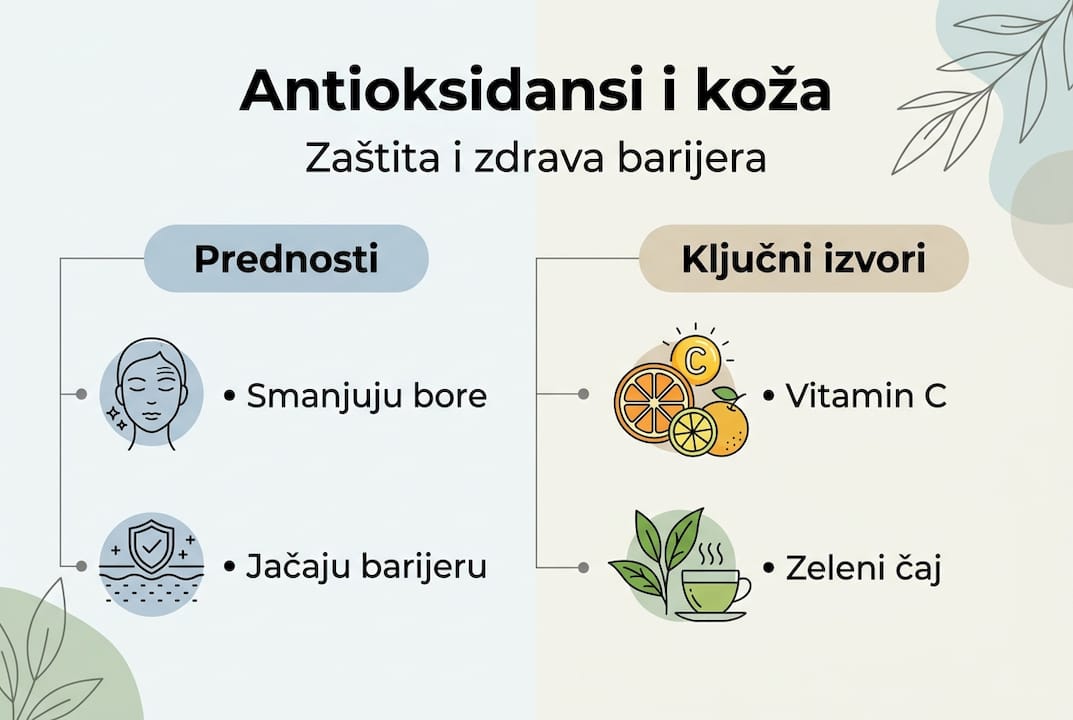
Antioxidants help calm inflammation, reduce redness and strengthen the skin barrier, while natural forms such as vitamins C and E and green tea extract are especially interesting. This can be important for people with rosacea, chronic sensitivity or skin prone to redness.
The benefits of antioxidants for sensitive skin include:
- Reducing inflammatory processes: vitamin C and polyphenols can help reduce inflammatory reactions in the skin
- Soothing redness: green tea extract and vitamin E help calm skin reactivity
- Supporting the skin barrier: antioxidants can help support the balance of lipids that form the skin’s protective layer
- Faster recovery: after irritation or sun exposure, antioxidants help the skin return to balance more easily
- Support for skin prone to rosacea: regular and correct use can help reduce the frequency and intensity of redness
Find more tips for sensitive skin and learn how to choose products according to your skin’s needs.
Professional tip: If your skin is very sensitive, start with formulas containing vitamin E and green tea extract before introducing vitamin C, because vitamin C in high concentrations can sometimes feel too intense for reactive skin. Always check the safety of natural ingredients in the products you use.
Synergy, best sources and effectiveness: what studies show
After learning about the benefits for sensitive skin, it is time to look at more concrete indicators of effectiveness and source recommendations.
One important conclusion from newer research is that antioxidants often work better in combination than individually. This synergy is not just a marketing story, but a concept supported by science. Vitamin C reduces oxidation by 30% more than vitamin E when used alone, while topical antioxidants can reduce UV damage by 25 to 86%, depending on the formulation and combination of ingredients.
| Antioxidant | Main benefit | Effectiveness alone | Effectiveness in combination |
|---|---|---|---|
| Vitamin C | Collagen, pigmentation | High | Very high |
| Vitamin E | Barrier, moisture | Medium | High |
| Glutathione | Detoxification, skin tone | Medium | High |
| Polyphenols | Anti-inflammatory action, UV protection | Medium | High |
| SOD | Neutralisation of free radicals | High | Very high |
Key figure: The combination of vitamins C and E can reduce UV damage up to 4 times more effectively than using only one of these antioxidants.
When choosing anti-age creams or serums, check whether they contain multiple antioxidants in a synergistic formulation. Products that combine vitamin C with vitamin E and ferulic acid show particularly good results in clinical studies.
For those who want to learn more about natural ingredients for wrinkles, it is important to understand that consistent use is just as important as choosing the right ingredient. Results are not visible immediately, but regular use over 8 to 12 weeks can bring measurable changes in skin texture and tone.
Safe use and common mistakes when using antioxidants
Although antioxidants can bring many benefits, it is easy to make mistakes that reduce or cancel out their effect.
Very high doses of some antioxidants can have a pro-oxidant effect, which means that too many active ingredients can paradoxically cause exactly what we are trying to prevent. For sensitive skin, it is especially important to test every new product and avoid potential irritants. Synergistic combinations are often a better choice than isolated high concentrations.
Here are practical steps for safe use:
- Test on a small area: Apply the new product to the inner forearm and wait 24 hours before applying it to the face.
- Start with lower concentrations: For example, introduce vitamin C in a 10% formulation before moving to 20%.
- Combine wisely: Vitamin C in the morning, retinol in the evening. Antioxidants and SPF should always go together.
- Store products properly: Vitamin C oxidises when exposed to light and air, so choose dark bottles with a pump.
- Be patient: Visible results usually come after regular use for at least 6 to 8 weeks.
- Consult a professional if a reaction occurs: If you notice increased redness or stinging, reduce the frequency of use and, if needed, consult a dermatologist.
Professional tip: Do not combine high doses of vitamin C with AHA acids in the same step of your routine because this can increase the risk of irritation. Instead, separate them between your morning and evening routine. You can learn more about safe cosmetic use on our blog.
The most common mistakes include using too many different antioxidants at once, skipping SPF when using antioxidants and having unrealistic expectations about how quickly results will appear. Antioxidants are an investment in long-term skin health, not an overnight fix.
What experts and experience reveal: common myths and the real truth about antioxidants
From theory and research, we now move into practice: what truly works, and what is just a myth?
One of the most common misconceptions is the belief that one good antioxidant is enough. Experts generally agree on the benefits of antioxidants, but they also warn against overdoing concentrations. Experience and research show that thoughtful combinations often work better than isolated high doses. Skin is not a laboratory where one ingredient solves everything.
Another common misconception is that antioxidants can replace SPF. They cannot. They work in a complementary way and help reduce damage that UV rays can still cause, but without SPF they are not sufficient protection.
The third misconception is impatience. Many people give up after two weeks because they do not see a dramatic change. Skin renews more slowly than we would like, and the real effect of antioxidants becomes visible only with consistent use. That is why it is important to give your routine enough time and not change products too quickly.
Our experience shows that people who combine vitamin C in the morning with vitamin E and SPF, and add polyphenols in the evening, often see the most visible and long-lasting results. Simplicity and consistency almost always beat overly complex routines.
How to choose and order natural antioxidants for your routine
Now that you know how antioxidants work and which combinations can bring results, the next step is to find formulations that suit your skin and that you can use reliably every day.
In the La PIEL webshop, you can find carefully selected face care products with natural antioxidants adapted to sensitive skin. Our natural body care includes formulas rich in vitamin E and plant-based ingredients for daily skin care and protection. For the youngest and most sensitive skin, the special Baby & Kids care range is designed with gentle formulations without unnecessary irritants. The La PIEL expert team is available for all your questions, and ordering is fast and secure.
Frequently asked questions about antioxidants in skincare
Which natural antioxidants are best for sensitive skin?
Vitamin C, vitamin E and green tea extract are especially interesting because they can help reduce inflammatory processes and support the skin barrier without the need for harsh ingredients.
Can you overuse antioxidants in cosmetics?
Yes, very high doses of some antioxidants can have a pro-oxidant effect and increase the risk of irritation, which is why every new product should be introduced gradually.
Do antioxidants replace sunscreen?
No, antioxidants are not a replacement for SPF. They work in a complementary way and are best combined with appropriate UV protection.
How can I know if antioxidants suit me if my skin is very reactive or allergy-prone?
Always test the product on a small area of skin and choose gentle formulations with a minimal number of ingredients to reduce the risk of reaction.
