
- Key ingredients for sensitive and dry skin include hyaluronic acid, ceramides and shea butter.
- Natural ingredients such as oats and aloe vera can help hydrate, soothe and care for the skin.
- Simple combinations with well-researched ingredients often provide the best long-term results.
Every time you stand in front of a shelf of skincare products or scroll through an online store, you are faced with dozens of promises and hundreds of ingredients. For dry and sensitive skin, that choice can be more than confusing - the wrong ingredient or formula may cause redness, stinging or further dryness. This guide offers a clear framework: which ingredients have strong professional and research support, what to look for when your skin is sensitive, and how to combine them meaningfully in an everyday routine. No unnecessary complications, just a focus on what your skin actually needs.
Contents
- How to identify the best ingredients for sensitive and dry skin
- The most important hydrating ingredients: hyaluronic acid and ceramides
- Soothing and nourishing ingredients: shea butter, oats and aloe vera
- Comparison of key ingredients for dry and sensitive skin
- Our perspective: why simple combinations can be so effective
- Natural facial skincare: find the right product for you
- Frequently asked questions
Key takeaways
| Point | Details |
|---|---|
| Choose ingredients your skin tolerates well | Avoid ingredients that you know trigger irritation and focus on well-researched, gentle formulations. |
| Hydration is the foundation | Hyaluronic acid helps hydrate the skin, while ceramides support its protective barrier. |
| Soothing ingredients can reduce discomfort | Ingredients such as colloidal oatmeal, aloe vera and shea butter may help ease dryness and discomfort. |
| Simplicity often works best | Simple, well-formulated routines are often easier to tolerate and maintain, especially for sensitive skin. |
How to identify the best ingredients for sensitive and dry skin
Before buying any new product, it helps to have a simple system for deciding whether it is right for you. Not every natural ingredient is automatically gentle on sensitive skin, just as not every synthetic ingredient is problematic. Formula quality, ingredient concentration and your skin's individual tolerance all matter.
Here are four basic criteria to consider when choosing a product:
- A suitable formula - Check the ingredient list (INCI) and learn about potentially problematic cosmetic ingredients for certain skin types. The length of an INCI list alone does not tell you whether a formula is good or bad; the function of the ingredients, their concentration and the way the product is formulated matter more.
- Skin tolerance - Every person's skin is different. What works beautifully for a friend may still cause a reaction for you. If your skin is very reactive, patch test a new product on a small area before applying it to your whole face.
- Well-researched ingredients - Prioritise ingredients with solid dermatological and research support. Hyaluronic acid, ceramides and colloidal oatmeal are often used in formulas for dry and sensitive skin, while shea butter can provide additional emollient and occlusive care.
- Avoiding potential irritants - Ingredients such as certain alcohols, fragrances and acids can aggravate dry or sensitive skin, especially when the skin barrier is already compromised. Rather than dividing ingredients into "natural" and "synthetic", choose formulas your skin tolerates well.
It is also important to understand the role of emollients in an everyday routine. Emollients soften and smooth the skin by filling the spaces between surface cells, helping the skin feel more flexible and comfortable. Without enough emollient support, dry skin can remain rough and prone to cracking.
"With sensitive skin, it is often helpful to choose gentle, fragrance-free formulas with fewer potential irritants, especially when the skin barrier is already compromised."
Professional tip: Regardless of age, priorities for dry and sensitive skin should include hydration, supporting the skin barrier and daily sun protection. A combination of humectants, emollients and antioxidants can be a strong foundation for a balanced routine.
Ingredient synergy matters just as much as any single ingredient. A well-formulated product can provide hydration, barrier support and a soothing feel at the same time, but more ingredients do not automatically mean better results.
The most important hydrating ingredients: hyaluronic acid and ceramides
Dry skin is often associated with a lack of lipids, increased water loss and a weakened protective barrier. In this type of routine, hyaluronic acid and ceramides can be especially useful because they play different but complementary roles.
Hyaluronic acid is a naturally occurring polysaccharide found in the skin, joints and eyes. Its key property is its ability to bind water. In cosmetic formulas, hyaluronic acid can improve hydration and help the skin retain a soft, plump feel, which is why it is one of the most commonly used humectants in skincare. Humectants help attract and retain water in the skin's surface layers.
Hyaluronic acid is available in different molecular sizes:
- High-molecular-weight hyaluronic acid mainly works on the skin's surface and can help reduce water loss
- Low-molecular-weight hyaluronic acid has a smaller molecular size and may act within the upper layers of the skin depending on the formulation
- A blend of different molecular weights in one formula can help support hydration across multiple levels of the skin's surface
For a comfortable hydrating effect, serums and creams with hyaluronic acid can be applied to slightly damp skin, followed by a moisturiser to help seal in moisture.
Ceramides are lipids that naturally make up a large part of the skin's protective barrier. When that barrier is weakened, the skin loses moisture more easily and may become more reactive or prone to redness. Formulas with ceramides can help support barrier function and reduce moisture loss, which can be especially useful for dry and reactive skin.
Here is how these two ingredients complement each other:
- Hyaluronic acid helps attract and retain moisture in the skin
- Ceramides help replenish lipids in the skin barrier and reduce moisture loss
- Together, they can provide a complementary approach to hydration and barrier support
Learn more about how ceramides and emollients work together to support a resilient skin barrier. Understanding the effects of hyaluronic acid can also help you choose the right product for your routine.
Professional tip: After cleansing, you can apply hydrating products while the skin is still slightly damp. Finishing with a moisturiser can help retain moisture and reduce the feeling of tightness.
Soothing and nourishing ingredients: shea butter, oats and aloe vera
Hydration is essential, but dry and sensitive skin often benefits from more than hydration alone. Ingredients that soften, soothe and support the skin barrier can add another important layer of care. Three natural ingredients stand out in this context.
Shea butter is a plant butter derived from the fruit of the shea tree (Vitellaria paradoxa) and has been used in skincare for generations. It is rich in fatty acids such as oleic, stearic and linoleic acids, along with naturally occurring compounds that help moisturise and care for dry skin, mainly by softening the skin and reducing moisture loss. It can be especially useful for skin exposed to cold weather, wind or air-conditioned environments. Shea butter also acts as an occlusive, forming a protective layer on the skin's surface that helps reduce water loss.
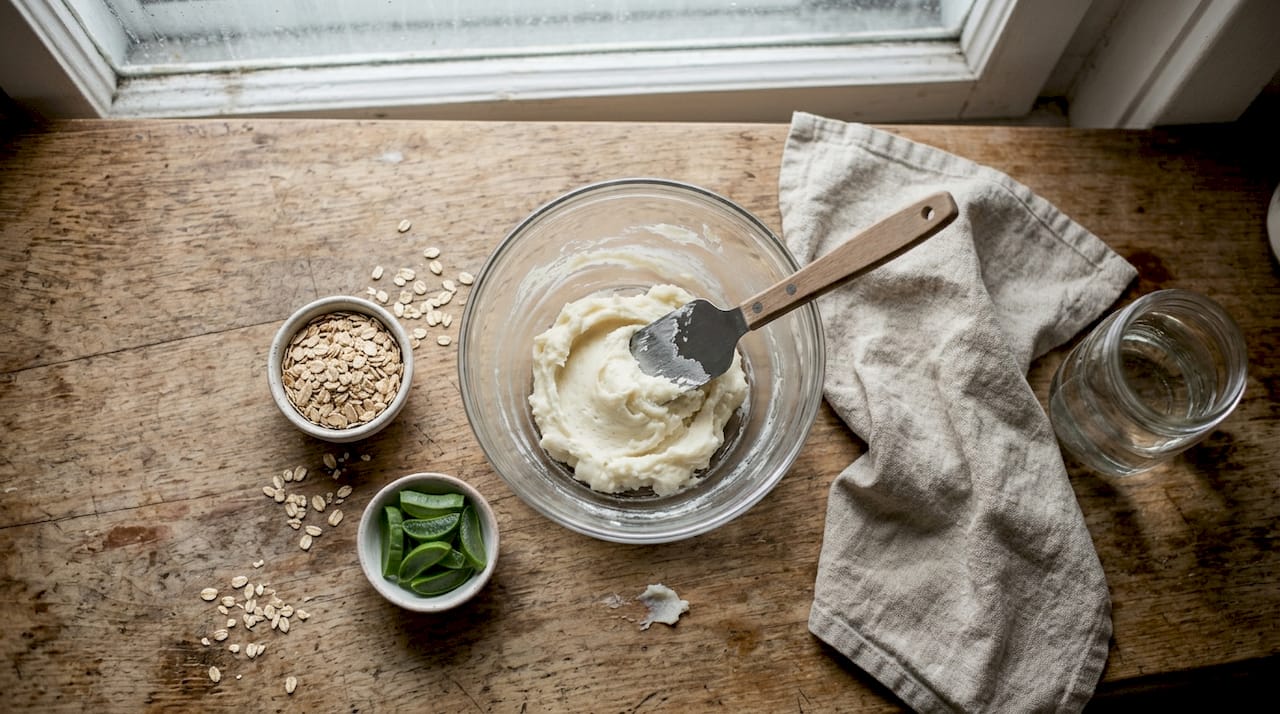
Colloidal oatmeal (Avena sativa) is finely processed oatmeal commonly used in products for dry, sensitive and irritated skin. Colloidal oatmeal can help soothe irritation and may support hydration and skin-barrier function, making it a common choice for skin prone to redness, itching and dryness. It contains beta-glucans and avenanthramides, compounds associated with hydrating and soothing properties.
Aloe vera is a plant-derived ingredient whose gel is commonly used in hydrating and soothing formulas. It can contribute to a hydrated, comfortable feel, especially in lightweight products for dehydrated or irritated skin. Learn more about the use of aloe vera in everyday skincare.
Key benefits of these three ingredients:
- Shea butter: intensive care, softness and reduced moisture loss
- Colloidal oatmeal: soothing care, skin-barrier support and hydration
- Aloe vera: lightweight hydration and a soothing feel
"For very sensitive skin, prioritise fragrance-free formulas with fewer potential irritants. Natural fragrance ingredients, including some essential oils, can also trigger reactions in reactive skin."
These three ingredients can complement one another in a balanced routine: shea butter softens and helps protect against moisture loss, colloidal oatmeal soothes, and aloe vera provides lightweight hydration. You can also read more about how plant extracts in facial skincare can fit into your routine on our blog.
Comparison of key ingredients for dry and sensitive skin
Once the individual ingredients are clear, it helps to compare them side by side so you can quickly identify which options best match your skin's current needs.
| Ingredient | Main function | Best suited for | Potential considerations |
|---|---|---|---|
| Hyaluronic acid | Attracts and retains moisture | Dehydrated and dry skin of all types | Rarely problematic; sensitive skin may still react to certain formulations |
| Ceramides | Supports the protective skin barrier | Dry, reactive skin and compromised skin barriers | Generally well tolerated; reactions depend on the complete formula |
| Shea butter | Rich emollient and occlusive care | Very dry and rough skin | Its richer texture may not suit every skin type |
| Colloidal oatmeal | Soothing and barrier-supporting care | Sensitive, red or itchy skin | Rarely problematic; people with a known oat allergy should be cautious |
| Aloe vera | Lightweight hydration and soothing care | Dehydrated and irritated skin | Rarely problematic; a patch test can be useful for very reactive skin |
A combination of ceramides, shea butter and oat extracts can be a strong base for a dry and sensitive skin routine because it can simultaneously support the barrier, soften the skin and provide soothing care. Each ingredient has a different role, so they can complement one another in a well-formulated product.
Recommendations for specific skin concerns:
| Skin concern | Recommended ingredients | Combination for added support |
|---|---|---|
| Extreme dryness | Shea butter, ceramides | Add hyaluronic acid for extra hydration |
| Redness and irritation | Colloidal oatmeal, aloe vera | Ceramides for barrier support |
| Early fine lines and loss of elasticity | Hyaluronic acid | Shea butter for additional emollient care |
| Reactive, sensitive skin | Ceramides, colloidal oatmeal | Aloe vera for a soothing feel |
Understanding how hyaluronic acid works alongside other ingredients can help you build a routine that reflects your skin's real needs instead of relying only on generic recommendations.
Our perspective: why simple combinations can be so effective
At La PIEL, we often see the same pattern: complicated routines with many products can make it harder to identify what actually works for the skin. With dry and sensitive skin, a simpler routine often makes it easier to track reactions and stay consistent.
What matters more than the number of ingredients is whether they are appropriate for the skin's needs and formulated well together. With reactive skin, being cautious about introducing many new active ingredients at once can also make it easier to identify a potential cause of irritation.
A strong foundation for dry and sensitive skin often includes lipids, humectants and soothing ingredients such as colloidal oatmeal, exactly as described in this guide. Emollients also play an important role by softening the skin and complementing the action of humectants. A consistent routine that your skin tolerates well usually makes more sense than frequently changing a large number of products.
Natural facial skincare: find the right product for you
Now that you know which ingredients are worth looking for, the next step is choosing products whose formulas match your skin's needs. La PIEL products are developed with carefully selected ingredients and a focus on comfortable, effective everyday skincare, and they are made in Croatia.
In our range of facial skincare products, you will find formulas with targeted hydrating and nourishing ingredients for different skin needs. If you are looking for a more complete routine, explore our natural body care products as well. Your skin deserves a carefully selected formula that responds to its real needs.
Frequently asked questions
How can I tell which ingredient suits my skin best?
Choose according to your skin type and its current condition. If your skin is very reactive, test a new product on a small area first. Natural ingredients can also cause unwanted reactions.
Can I combine hyaluronic acid and ceramides in the same routine?
Yes. Hyaluronic acid helps attract and retain moisture, while ceramides support the skin's lipid barrier, so the two ingredients can complement each other well in the same routine.
Which ingredients should I avoid with sensitive and dry skin?
With sensitive and dry skin, it is often helpful to avoid fragrance and overly aggressive formulas. Certain types of alcohol or acids may be irritating, but tolerance depends on the ingredient itself, its concentration and the complete formulation.
What are humectants and why are they important?
Humectants are ingredients that help attract and retain water in the skin's surface layers. Hyaluronic acid is one of the best-known humectants and is commonly used in formulas for dry and dehydrated skin.
