
You are standing in front of a drugstore shelf, looking at rows of bottles that promise things like “100% natural” or “eco formula.” Sounds familiar? Confusion about what is truly natural and what is only marketing is one of the most common frustrations for people who care about their skin. We apply dozens of products to the face and body every week, often without really knowing what is inside them. This guide will help you recognise quality natural ingredients, learn how to read product labels, choose what suits your skin and avoid the most common mistakes that can slow down visible results.
Content
- Why choose natural ingredients for skincare
- How to recognise real natural ingredients
- How to choose ingredients according to skin type and needs
- Common mistakes and how to check ingredient effectiveness
- Our perspective: what people often forget when choosing natural ingredients
- Open the door to natural care with La PIEL
- Frequently asked questions
Key takeaways
| Point | Details |
|---|---|
| Read labels carefully | Always check the INCI list to better understand what is really inside the product. |
| Choose according to skin type | Each skin type responds better to certain natural ingredients, so choose based on your real skin needs. |
| Be consistent with your routine | Natural ingredients require regular use, and visible results usually appear after several weeks. |
| Avoid popular myths | There is no perfect ingredient for everyone — test carefully and choose individually. |
Why choose natural ingredients for skincare
Once we understand the need for a more careful choice, it becomes important to look at the benefits natural ingredients can bring. Natural cosmetics are not just a trend. For skin that is starting to show the first signs of ageing, loss of elasticity, dehydration or uneven tone, the right ingredient choices can make a real difference. Well-selected natural ingredients work with the skin, not against it.
Key benefits of natural ingredients include:
- Hydration: Natural humectants such as glycerin and aloe vera help attract moisture to the skin and keep it there for longer. Natural ingredients increase skin hydration by 35%, which can be a measurable benefit compared with some less skin-friendly alternatives.
- Antioxidants: Vitamin C, green tea and resveratrol help protect the skin from free radicals that contribute to visible ageing and oxidative stress.
- SPF support: Some naturally derived mineral ingredients, such as zinc oxide and titanium dioxide, provide physical UV protection without traditional chemical filters.
- Soothing effect: Shea butter, chamomile and lavender can help reduce the feeling of discomfort and support reactive or sensitive-looking skin.
For adult skin, dermatologist recommendations often point to hydration, antioxidants and SPF protection as the foundation of an effective routine. It is also important to know that results usually require 8 to 12 weeks of consistent use, which means patience is not optional — it is part of the process.
Natural cosmetics can also offer an environmental advantage. Fewer unnecessary synthetic ingredients can mean less environmental burden and a lower risk of unwanted reactions for some skin types. Research on the safety and effectiveness of natural ingredients shows that well-formulated natural products can be highly effective, especially when the formula is balanced and adapted to the skin’s needs.
“Skin reflects inner health, but what we apply on the outside also shapes its resilience and appearance.”
Favourite ingredients worth looking for on labels include aloe vera (hydration and soothing), vitamin C (glow and antioxidant protection), green tea (support against free radicals), shea butter (rich nourishment for dry skin) and jojoba oil (comfort, softness and sebum-balancing support). Each of them has a clear function and is generally well tolerated by many skin types.
How to recognise real natural ingredients
After understanding the benefits, the next step is learning how to recognise what is actually natural. The key is reading product labels — something many of us skip because the list can look intimidating. But there is a logic behind it.
The INCI list (International Nomenclature of Cosmetic Ingredients) is the standardised list of all ingredients on a product label, listed from the highest to the lowest concentration. Natural ingredients often appear as Latin botanical names, for example Aloe Barbadensis Leaf Juice or Butyrospermum Parkii (shea butter). Synthetic ingredients often have chemical names or prefixes such as “propyl,” “methyl” or “ethyl.”
How to read a label step by step:
- Check the first five ingredients. They usually make up the largest part of the formula.
- Look for Latin plant names as a sign of botanical origin.
- Be mindful of ingredients often considered undesirable in cosmetics, such as parabens, sulphates, silicones, PEG compounds, synthetic fragrances and mineral oils.
- A shorter ingredient list can often mean a simpler, more focused formula.
- Look for certifications such as COSMOS Organic, ECOCERT or Natrue when available.
More about recognising natural cosmetics shows that many products marketed as “natural” can still contain ingredients such as parabens, sulphates or silicones, which some people prefer to avoid, especially if their skin is sensitive or reactive.
| Label | What it means | What to watch for |
|---|---|---|
| Organic / Eco | Ingredients grown according to organic or eco standards | The certificate should be clearly stated |
| Vegan | No animal-derived ingredients | Does not automatically mean natural |
| Cruelty free | Not tested on animals | Independent from how natural the ingredients are |
| COSMOS Organic | A recognised standard for natural and organic cosmetics | One of the more reliable certification systems |
It is also worth understanding the role of glycerin in natural cosmetics. Glycerin is one of the most common skincare ingredients. It can be plant-derived or synthetic, and plant-based glycerin is often labelled as “vegetable glycerin” or Glycerin (vegetable).

Professional tip: Install an app such as Think Dirty or CosDNA on your phone. You can scan a product barcode or manually enter ingredients to get more information about their function, safety profile and origin. This is especially useful when you are shopping quickly and do not have time to read small print in detail.
How to choose ingredients according to skin type and needs
Once you know how to recognise natural ingredients, the most important step is choosing what actually suits your skin. Even the highest-quality natural ingredient can be the wrong choice if it does not match your skin type or current skin condition.
First, identify your skin type:
- Dry skin: Feels tight, especially after cleansing. It is prone to flaking and fine lines.
- Oily skin: Looks shiny, especially in the T-zone. It is often prone to enlarged pores and breakouts.
- Combination skin: Oily T-zone (forehead, nose, chin) with drier cheeks.
- Sensitive skin: Reacts with redness, stinging or itching to many products or environmental changes.
Recommendations according to skin type and goals:
| Skin type | Recommended ingredients | What to avoid |
|---|---|---|
| Dry | Shea butter, hyaluronic acid, avocado oil | Alcohol, menthol |
| Oily | Niacinamide, tea tree, aloe vera | Coconut oil, heavy oils |
| Combination | Jojoba oil, green tea, niacinamide | Too many layers of rich creams |
| Sensitive | Chamomile, aloe vera, oat extract | Essential oils, high concentrations of vitamin C |
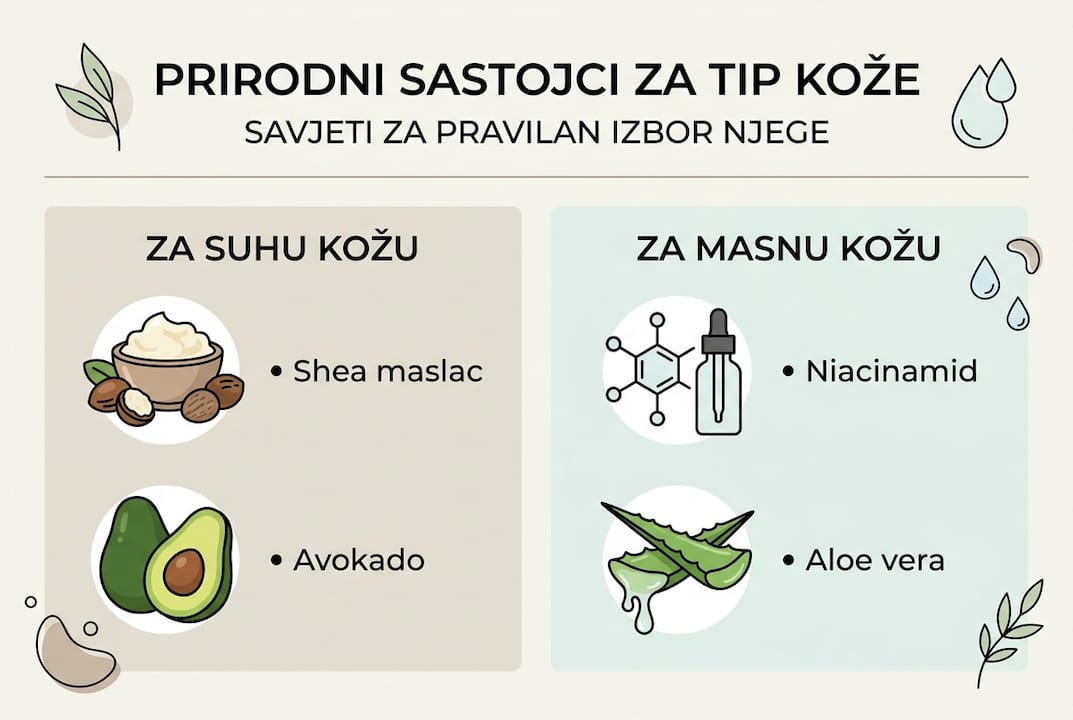
It is equally important to know when certain ingredients should be used carefully. For example, possible side effects of niacinamide show that niacinamide and essential oils may irritate very sensitive skin in some cases, while coconut oil can be comedogenic, meaning it may clog pores and worsen breakouts in acne-prone or oily skin.
Daily routine tips according to skin type:
- Dry skin: Morning cleanse with a gentle gel, hyaluronic acid serum, rich cream with shea butter, SPF.
- Oily skin: Foaming cleanser, lightweight lotion with niacinamide, oil-free gel SPF.
- Sensitive skin: Fragrance-free micellar water, serum with aloe vera and chamomile extract, minimalist cream.
Tips for sensitive skin and natural choices for oily skin can help you find more specific combinations that may work for your skin.
Professional tip: If you are not sure what your skin type is, wash your face with a gentle cleanser and apply nothing for one hour. If your skin becomes shiny, it is likely oily. If it feels tight or dry, it is likely dry. If only the T-zone becomes shiny, it is probably combination skin.
Common mistakes and how to check ingredient effectiveness
Choosing the right ingredient is only part of the process. It is just as important to avoid common mistakes and know how to evaluate whether something is really working. Many people give up on natural products too early or use them incorrectly, so they never see the results they were hoping for.
The most common mistakes to avoid:
- Skipping the patch test: Always test a new product on the inner forearm for 24 to 48 hours before applying it to the face. Even natural ingredients can cause a reaction.
- Unrealistic expectations: Natural products are not a magic wand. Results usually require 8 to 12 weeks of consistent use, not just one week.
- Mixing too many new products at once: If you introduce five new products at the same time and your skin reacts, you will not know which one caused it. Introduce one at a time, with a one- to two-week gap.
- Using one plant oil for every skin type: Every oil has a different fatty acid profile and suits different skin types. Jojoba oil is lightweight and often works well for oily skin, while avocado oil is usually better suited to dry skin.
- Ignoring signs of irritation: If you notice redness, burning, itching or a rash, stop using the product and do not wait for the reaction to “go away on its own.”
How to measure results and track progress:
- Photograph your skin under the same lighting once a week, always at the same time of day.
- Keep a short routine diary: what you used, when you used it and how your skin felt.
- Track specific changes: hydration, glow, texture, pore appearance, redness.
“Consistency is the only real luxury in skincare. Without it, even the most expensive ingredient cannot deliver the results you expect.”
Signs that an ingredient does not suit your skin are usually clear: increased redness, burning on application, new rashes or breakouts that were not present before, or dryness that gets worse instead of better. You can find more practical information and skincare advice on our natural cosmetics blog.
Our perspective: what people often forget when choosing natural ingredients
After all the instructions and tips, it is worth taking a step back and looking at the bigger picture. At La PIEL, we speak every day with people who have tried dozens of products and are still searching for “the one.” What we often notice is the same pattern: the focus is on the ingredient, not on the skin.
Trends come and go. One year everything is about retinol, the next about bakuchiol, then peptides. Each of those ingredients can be excellent — but only if it suits your skin at this exact moment in your life. Skin changes with age, hormones, seasons, stress and lifestyle. What worked at 28 does not always work at 40.
Our honest recommendation is to stop looking for the perfect ingredient and start listening to your skin. Testing, observing and being patient are the only reliable tools. A natural approach to skincare does not mean following trends. It means building a routine that works for you — long-term and consistently.
Open the door to natural care with La PIEL
Every step you learned today, from reading the INCI list to recognising your skin type, can become part of your everyday routine right away. La PIEL products are created with this knowledge at the heart of the brand — handmade in Croatia, with carefully selected natural ingredients and a strong focus on quality.
Whether you are looking for natural face care tailored to your skin type, a body care collection that nourishes and supports the skin, or gentle La PIEL products for children, our range covers the needs of the whole family. If you have questions about which product best suits your skin, we are here for you. Contact us and we will help you find the right solution.
Frequently asked questions
How can I know if an ingredient is natural?
A natural ingredient is often listed on the INCI list under its Latin or English botanical name, without obvious synthetic prefixes. If you see names such as Aloe Barbadensis or Rosa Canina, they usually point to botanical origin, while names with prefixes such as “propyl” or “methyl” may indicate synthetic compounds.
Which natural ingredients are best for skin hydration?
Aloe vera, glycerin, shea butter and plant-derived hyaluronic acid are excellent choices for hydration because they help attract and retain moisture in the skin. They can be especially useful for dry and dehydrated skin when used consistently.
Can a natural ingredient cause irritation?
Yes. Even natural ingredients can cause reactions, especially on sensitive skin. Niacinamide and essential oils may not suit everyone, so a patch test is always recommended before introducing a new product into your routine.
How long does it take to see results from natural skincare products?
For most natural ingredients, visible changes usually require 8 to 12 weeks of regular and consistent use because the skin goes through a natural renewal cycle that takes several weeks.
