
Dry and sensitive skin requires special attention, and the beauty market is full of products that promise to be natural, but rarely truly deliver on that promise. If you have ever stood in front of a shelf of creams and wondered which one is actually safe for your skin, you are not alone. Many people go through the same process of trial and error, and the skin often pays the price. In this article, you will learn how to recognize a truly natural cream, which ingredients to look for, which ones to avoid, and how to safely test a new product without unnecessary fear of irritation.
Contents
- Why choosing the right natural cream matters
- First steps: what to check on the packaging
- Key ingredients for dry and sensitive skin
- Ingredients to avoid
- How to apply and test a natural cream
- Natural solutions and safe choices: next steps
- Frequently asked questions about choosing a natural cream
Key takeaways
| Point | Details |
|---|---|
| Look for reliable certifications | Certifications such as COSMOS, ECOCERT and NaTrue can help confirm the natural origin and formulation standards of a product. |
| Focus on humectants | Glycerin and hyaluronic acid are excellent choices for hydrating dry and sensitive skin. |
| Avoid potential irritants | Pay attention to synthetic fragrances, PEGs, certain preservatives and some essential oils that may cause reactions in sensitive skin. |
| Test before use | Always test a small amount of cream on the forearm before applying it to the face. |
| Learn how to read the INCI list | Ingredients at the beginning of the list make up the largest part of the formula and have the biggest impact on the feel, effectiveness and tolerance of the product. |
Why choosing the right natural cream matters
Dry skin loses moisture faster than it can retain it, while sensitive skin often reacts to the wrong ingredient. Redness, stinging, flaking and tightness are not only uncomfortable; they are also signs that the skin needs better protection. That is why choosing a cream is not a trivial decision.
The challenge is that the term “natural cosmetics” is not always clearly defined or understood in the same way. This means the claim is sometimes used very broadly, even when a formula contains only a small percentage of plant extracts. The result? Creams that look natural at first glance, while their INCI list tells a completely different story.
Look for certifications such as COSMOS, ECOCERT, NaTrue or BDIH on the packaging if you want extra confirmation that a product follows stricter natural cosmetics standards.
Certifications are one of the most reliable tools you have when shopping. The organizations that issue them review ingredients, production processes and the proportion of natural components. Without certification, your choice relies more on the brand’s transparency, the clarity of the label and trust in the manufacturer.
When choosing a cream, pay attention to the following:
- The presence of a recognized certification on the packaging
- The brand’s transparency about ingredient origin
- A short, clear and understandable INCI list
- The absence of potentially irritating fragrances and harsh ingredients
For a deeper understanding of which natural hydrating ingredients really work, it is worth doing a little research before buying.
First steps: what to check on the packaging
Now that we have explained why the right choice matters, let’s move on to practical checks you can apply immediately. A cream’s packaging contains more information than it may seem at first glance.
First, look for certification. The COSMOS, ECOCERT, NaTrue or BDIH logo is usually placed on the back or bottom of the packaging. If there is no certification, it does not automatically mean the product is bad, but it does mean you should read the formula more carefully and check how the brand communicates its ingredients.
The next step is reading the INCI list. INCI (International Nomenclature of Cosmetic Ingredients) is the standardized list of ingredients used on cosmetic products. Read the INCI list from the first ingredient to the last, because ingredients are listed from the highest to the lowest concentration. The first five ingredients usually make up the largest part of the formula.
Here is what that looks like in practice:
- Find the INCI list on the packaging; it is usually written in small print.
- Check the first five ingredients, because they form the base of the cream.
- Look for familiar ingredients such as Aloe Barbadensis, Butyrospermum Parkii or Glycerin.
- If Parfum, Dimethicone or PEG compounds appear high on the list, consider whether that formula is right for your skin.
- Compare several products before making the final decision.
| Criterion | With certification | Without certification |
|---|---|---|
| Ingredient verification | Independent organization | Manufacturer and declaration |
| Share of natural ingredients | Defined by certification standard | Not necessarily clearly defined |
| Transparency | High | Depends on the brand |
| Reliability of the “natural” claim | Confirmed according to a standard | Requires additional checking |
Professional tip: Apps such as Think Dirty or CosDNA can help you understand ingredients, especially if you are just learning how to read INCI lists. You can scan the barcode or manually enter ingredients to get a basic assessment of the formula. This can be especially useful when checking for harmful ingredients in cosmetics that are difficult to recognise without prior knowledge.
Key ingredients for dry and sensitive skin
Once you know how to recognise a reliable product, the next step is focusing on the ingredients that can truly make a difference. There are two important categories to understand: humectants and ingredients that support the skin barrier.
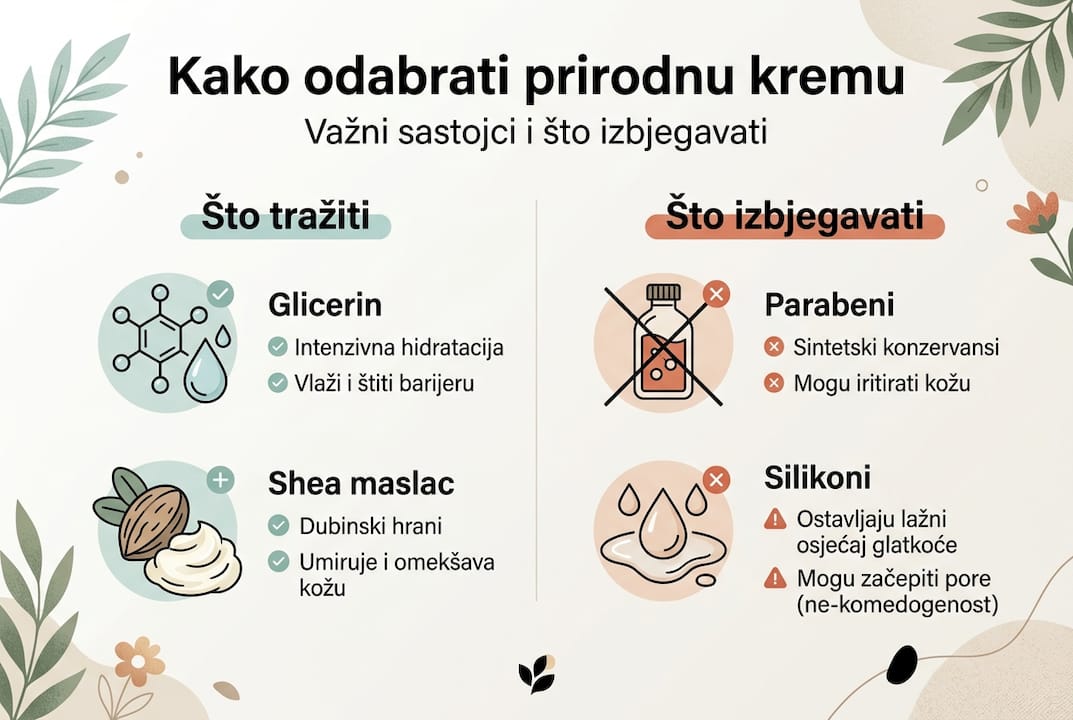
Humectants attract moisture and help keep it in the surface layers of the skin. For dry skin hydration, look for glycerin, hyaluronic acid and Sodium PCA. These ingredients help the skin maintain a longer-lasting feeling of hydration and comfort.

When it comes to the importance of glycerin, it is worth knowing that it is one of the most researched and well-tolerated hydrating ingredients, suitable even for sensitive skin.
Barrier-supporting ingredients help protect the skin from external stressors and reduce moisture loss. To soothe sensitive skin, look for ceramides, shea butter, squalane, aloe vera, colloidal oat, panthenol and CICA, also known as centella.
| Ingredient | Function | Skin type |
|---|---|---|
| Glycerin | Attracts and retains moisture | Dry, sensitive |
| Hyaluronic acid | Hydration and moisture retention | Dry, dehydrated |
| Ceramides | Skin barrier support | Sensitive, dry |
| Shea butter | Nourishment and protection | Dry, rough |
| Squalane | Softening and comfort | All skin types |
| Panthenol | Soothing and skin renewal support | Sensitive, irritated |
| CICA (centella) | Soothing effect | Sensitive, reactive |
On the label of a cream for dry and sensitive skin, it is ideal to see at least two humectants and one barrier-supporting ingredient within the first ten ingredients. If these elements are present, the cream has a good foundation for caring for dry and sensitive skin.
Professional tip: For dry skin, choose creams with richer and creamier textures. Lightweight gels and lotions often do not provide enough nourishing comfort, especially during colder months. You can find more about how to build a natural routine for dry skin in our detailed guide.
Ingredients to avoid
Alongside the ingredients worth looking for, it is also important to know what may cause problems for sensitive skin. This is especially important for skin that reacts quickly, intensely or unpredictably.
Ingredients to pay attention to:
- Parabens (methylparaben, propylparaben): preservatives that some consumers prefer to avoid in more natural formulas.
- Silicones (Dimethicone, Cyclopentasiloxane): they can create an instant smooth feel, but they do not suit every skin type and are not aligned with a natural approach to skincare.
- PEG compounds: common in conventional cosmetics, but usually avoided in natural formulas.
- Mineral oils (Paraffinum Liquidum): petrochemical derivatives that can create a heavy, occlusive feeling on the skin.
- Synthetic fragrances (Parfum): one of the common triggers of reactions in sensitive skin.
- Phenoxyethanol: a preservative that may cause discomfort or irritation in very sensitive skin.
These ingredients are worth checking carefully because they can also appear in products marketed as gentle or inspired by nature.
Surprisingly, some natural ingredients can also be problematic. Essential oils and coconut oil may irritate sensitive or acne-prone skin despite their natural origin.
The natural origin of an ingredient does not automatically mean it is ideal for every skin type. Sensitive skin may also react to plant extracts, essential oils and certain fruit acids.
If you notice redness, stinging or a rash after applying a new cream, stop using it immediately. If the symptoms do not calm down or become worse, consult a dermatologist. A more detailed list of harmful ingredients can help you navigate your next purchase more confidently.
How to apply and test a natural cream
Once you have recognised and chosen a cream that seems safe and well formulated, the next key step is using it correctly and evaluating the results. Even a very good cream can cause a reaction if the skin is particularly reactive or if there is an individual sensitivity to a specific ingredient.
Here is how to safely introduce a new cream into your routine:
- Patch test: Apply a small amount of cream to the inner forearm or behind the ear. Leave it on for 24 hours without rinsing.
- Observe the reaction: If there is no redness, itching or swelling, the cream is likely to be well tolerated by your skin.
- Introduce it gradually: For the first week, use the cream only in the evening so you can monitor how your skin reacts.
- Track changes: Keep short notes on how your skin feels, looks and reacts.
- Be patient: Natural formulas often require consistency. Give the product at least 4 weeks, unless your skin shows signs of irritation earlier.
Check certifications and the INCI list, then focus on ingredients that hydrate and support the skin barrier, especially if you have dry or sensitive skin.
Professional tip: Do not introduce several new products into your routine at the same time. If you start using a cream, serum and toner all at once, you will not know which product caused a possible reaction. One new product every two weeks is a good rule for sensitive skin. You can find more practical tips on testing natural skincare in our step-by-step guide.
Natural solutions and safe choices: next steps
Now that you know what to look for on the packaging, which ingredients to prefer and which ones to be careful with, you can approach your next purchase with much more confidence. Knowledge is your strongest tool when choosing a cream that will truly match your skin’s needs.
La PIEL offers handmade natural cosmetics produced in Croatia, with transparent formulas and carefully selected ingredients suitable for everyday care of dry and sensitive skin. The products are developed with a focus on comfort, effectiveness and ease of use, so skincare can feel gentle, but still concrete. If you are looking for reliable natural face care or want to expand your routine with high-quality natural body care, the La PIEL range offers practical answers to your skin’s needs.
Frequently asked questions about choosing a natural cream
Why is it important to look for certifications on a natural cream?
Certifications such as COSMOS, ECOCERT, NaTrue or BDIH confirm that a product follows specific independent standards for natural cosmetics. This is useful because the “natural” claim is often used broadly and is not always clear enough on its own.
Which ingredients should I avoid in natural creams?
If you want a more natural and gentle formula, pay attention to parabens, silicones, PEG compounds, mineral oils, synthetic fragrances and phenoxyethanol. For particularly sensitive skin, caution is also needed with essential oils because they may cause irritation.
Which ingredients should I look for to hydrate dry skin?
Look for glycerin, hyaluronic acid and Sodium PCA as humectants, and ceramides, shea butter, panthenol and squalane for skin barrier support and a greater feeling of comfort.
How can I be sure a cream will not irritate my sensitive skin?
Do a patch test on the inner forearm and wait 24 hours. If your skin is particularly reactive, choose simpler formulas without intense fragrances, essential oils and ingredients you already know do not suit your skin.
